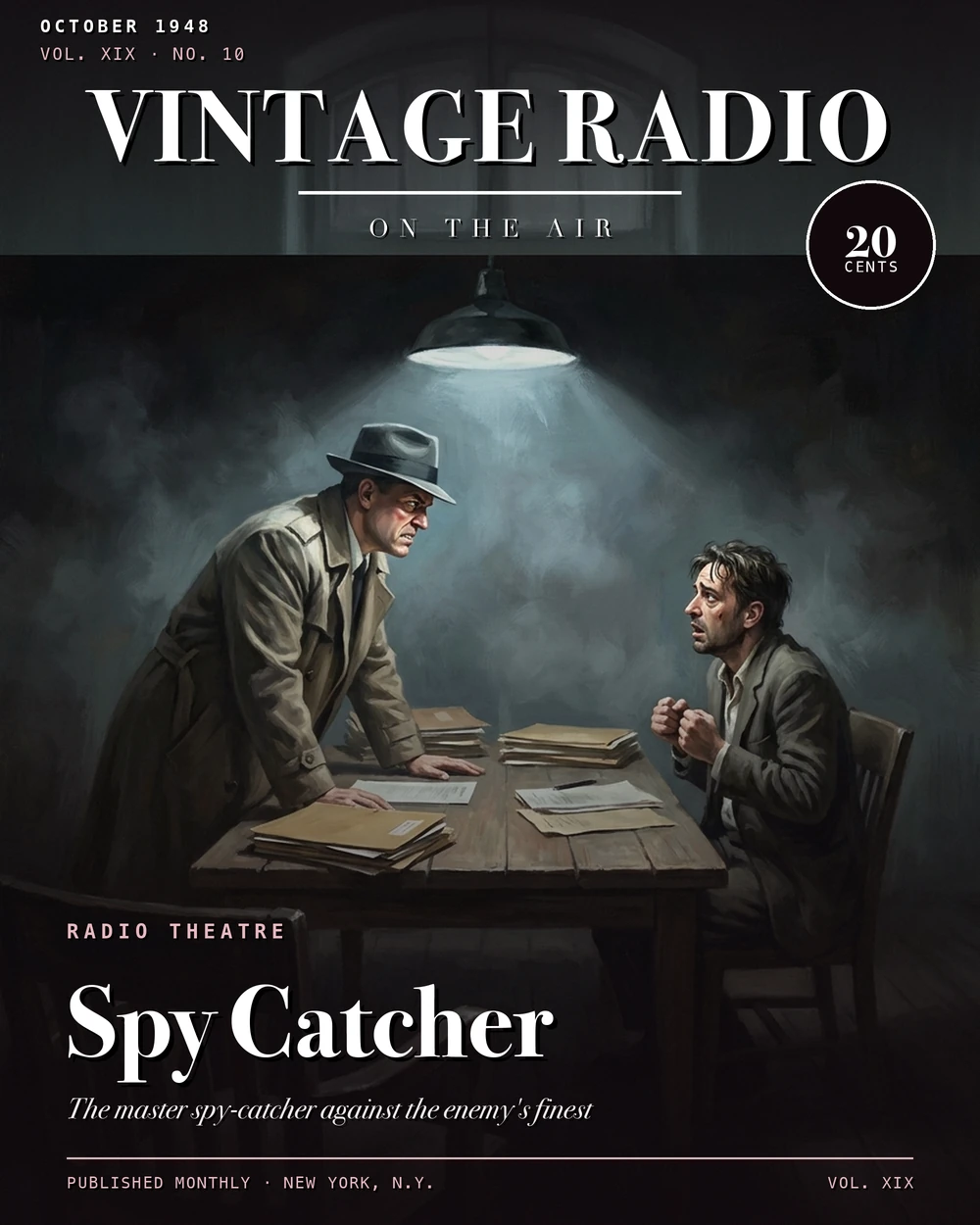
Spy Catcher
The Man Behind the Microphone
There is a particular kind of radio drama that works not on action and gunfire but on pressure — the slow tightening of a conversation until someone breaks. Spy Catcher was exactly that kind of show. Based on the wartime memoirs of Lieutenant-Colonel Oreste Pinto of the Allied Counter-Intelligence Service, each episode placed a Dutch intelligence officer alone in a room with a suspect and let the questioning do the work. It was taut, methodical, and grounded in fact, and it ran on BBC Radio from September 7, 1960 to October 18, 1961.
Pinto was no fictional creation. He served during World War II with both MI5 and the Dutch Politie Buitendienst, and his interrogations helped expose eight enemy agents, including the figure known as the "Traitor of Arnhem." General Eisenhower described him as "the greatest living expert in security." Pinto published his account under the title Spy Catcher in 1952, through Harper & Brothers in the United States and T. Werner Laurie in the UK, and that book became the direct source material for everything that followed.
How the Radio Series Came Together
The BBC had already put Pinto on television before the radio version arrived. A companion TV series, also called Spycatcher, ran from 1959 to 1961 and established the basic template: Bernard Archard playing Pinto, episode by episode, working through cases drawn from the memoirs. Writer-producer Elwyn Jones devised the television series — Jones would later co-create Z-Cars in 1962 and eventually become Head of BBC Drama (Series) from 1963 to 1966. Archard won the role after an audition with Jones, and by the time the radio adaptation launched he had already made Pinto his own.
Robert Barr wrote the scripts for the radio version, producing 26 episodes across two seasons. Of those, 24 recordings are known to survive, running to roughly ten hours and twenty-three minutes of audio. The first episode, "One Must Die," went out on September 7, 1960; the final listed episode, "Spitfire Johnny," aired on October 18, 1961. The gap between what was written and what survives is small, which makes this one of the more complete BBC radio drama records from the period.
The Way It Worked
The format was consistent and deliberately so. Pinto would face a political refugee or an apparent Allied serviceman whose story didn't quite hold together, and the episode would unfold as a psychological contest. He didn't chase or threaten — he listened, questioned, circled back, and waited for the contradictions to surface. The structure resembled what critics would later describe in terms of Columbo: the drama wasn't about discovering who had done something, but about watching a relentless, methodical mind work out exactly how to prove it.
Episode titles like "Neutral Ground," "Margin Of Error," "Left Luggage," and "Traitor In The Forest" give a sense of the range. Some cases were geographically grounded — "Neutral Ground" suggests wartime Europe's complicated buffer zones — while others, like "The Photograph" or "The Absent Friend," point toward the particular kind of detail that unravels a cover story. "Game Set Match" has the quality of a finished conclusion; "Never Say Die" suggests a suspect who didn't go quietly.
The production leaned hard into its documentary origins. The quasi-factual presentation was deliberate enough that Archard reportedly wasn't given a billing in the Radio Times until some way into the run — a choice that reinforced the impression that the listener was hearing something closer to a case record than a drama. It was a useful illusion, and it fit the material.
Bernard Archard and the Role
Archard — born August 20, 1916, and working steadily in British television and film until late in his career — brought a quality of still authority to Pinto that suited the character exactly. He was not a flashy performer. The role called for someone who could convey intelligence through restraint, and Archard managed that across both the television and radio versions of the franchise. His Pinto was a man who didn't need to raise his voice because he already knew more than the person across the table.
The role turned out to be a career marker. In the same year the board game inspired by the BBC television series was released — 1960, produced by J & L Randall under the Merit name — Archard appeared in Village of the Damned, the British science fiction film. Later came The Day of the Jackal in 1973 and two separate roles in Doctor Who. Spy Catcher was not his only significant work, but it was an early demonstration of the composed, authoritative screen presence he carried through decades of British drama.
What the Show Got Right
Radio suited this material in ways that might not be immediately obvious. Television could show you the room, the suspect's face, the flicker of anxiety. Radio made the listener do that work — picturing the pauses, filling in the expression that Pinto would have caught from the other side of the table. The psychological mechanics of interrogation, which depend heavily on silence and implication, translate naturally to audio. What you don't hear can be as telling as what you do.
The show also benefited from its source. Pinto's memoirs were not reconstructed or dramatized from the outside — they were his own account of cases he worked, shaped into narrative after the fact. That gave Barr's scripts something to push against: real events, real stakes, real outcomes. The fictional version had to honor the record while still building episode-by-episode tension around results the historical Pinto had already achieved. That's a particular kind of writing challenge, and the 26-episode run suggests it was one Barr navigated consistently.
Spy Catcher wasn't the loudest show on the air in 1960 and 1961. It didn't need to be. It operated on the quiet confidence of a man who had already done the work and just needed enough time to show you how.